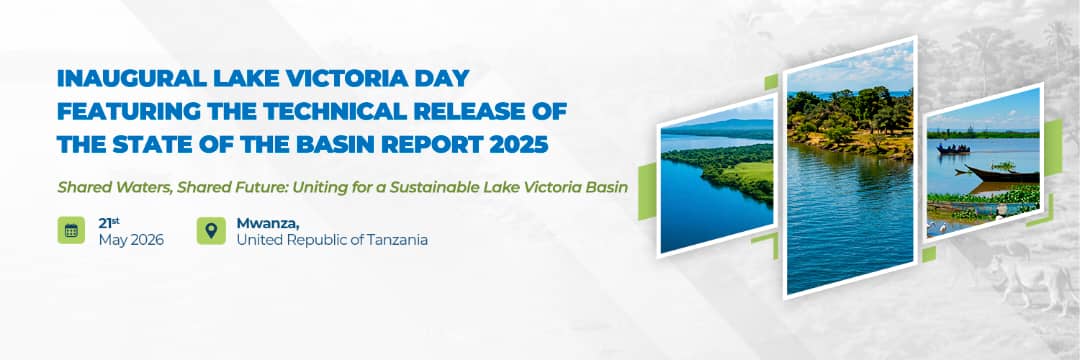
The Lake Victoria State of the Basin Report (2025) will be officially released during the inaugural Lake Victoria Day celebrations in Mwanza, United Republic of Tanzania, scheduled for 18th–21st May 2026.
Plans for the release have been finalized.
A preview edition of the report was first unveiled at a high-level side event during the United Nations Climate Change Conference (COP30) in Belém, Brazil, on 13th November 2025.
The report offers comprehensive insights into the ecological health, socio-economic dynamics, and governance trends of the Lake Victoria Basin, which is a home to more than 45 million people across five East African Community (EAC) Partner States.
Positioned as a landmark, evidence-based blueprint, the State of the Basin Report bridges local realities with regional policymaking, providing a shared platform for both national and transboundary action.
It informs investment decisions and national strategies on water quality, ecosystem and biodiversity conservation, climate resilience, and infrastructure development bringing together environmental, socio-economic, and governance data into a unified vision.
The report is designed to empower communities, development partners, and policy makers to collectively respond to challenges such as climate change, population growth, and environmental degradation, while safeguarding the basin’s natural resources as a foundation for sustainable development.
It also highlights the support and benefits from the long standing EAC-German cooperation and has been preparation through the EAC4Nature Project and draws on data from the Water Information System (WIS), financed by Germany’s Federal Ministry for Economic Cooperation and Development (BMZ) through KfW under the “Lake Victoria Basin Integrated Water Resources Management Programme.
The system has become a critical tool supporting the Lake Victoria Basin Commission (LVBC) in coordinating sustainable development and resource management across the basin.
LVBC Executive Secretary Dr. Masinde Bwire noted that the report clearly outlines the interconnected challenges facing the basin, including rapid population growth and changing land use, which are placing increasing pressure on its ecosystems.